Now let us from this table rise

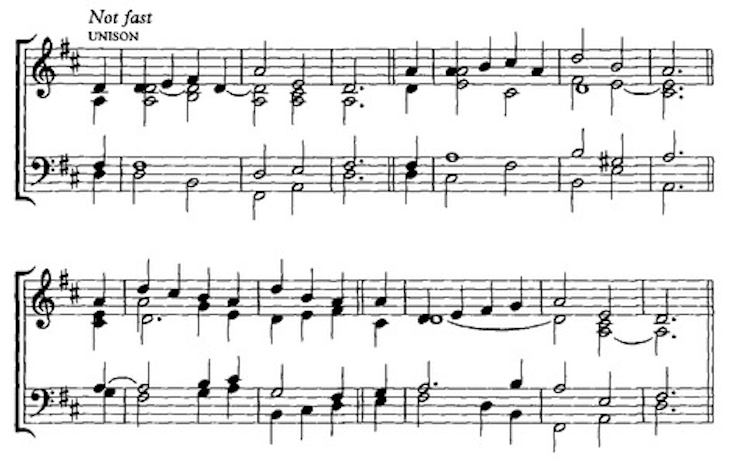
Now let us from this table rise
1 Now let us from this table rise,
renewed in body, mind, and soul;
with Christ we die and live again,
his selfless love has made us whole.
2 With minds alert, upheld by grace
to spread the word in speech and deed,
we follow in the steps of Christ,
at one with all in hope and need.
3 To fill each human house with love,
it is the sacrament of care;
the work that Christ began to do
we humbly pledge ourselves to share.
4 Then grant us courage, Father God,
to choose again the pilgrim way,
and help us to accept with joy
the challenge of tomorrow's day.
The author of this hymn, Fred Kaan (born Frederik Hermanus Kaan [1929-2009]), was born in Haarlem, the Netherlands. When he was quite young during World War II his parents were active workers in the Dutch Resistance. Later Kaan became interested in church and religion; he studied theology and psychology at Utrecht University but, introduced to Congregationalism by an English friend, in 1952 he enrolled in Western College (later part of Bristol University), a Congregationalist foundation, to study for the ministry. [The College closed in 1969.] He was ordained to Congregationalist ministry in 1955 and subsequently served in a church in Barry, South Wales, and then in the Pilgrim Church in Plymouth, where he began to write hymns. He produced his first collection, Pilgrim Praise, there in 1968. Kaan then spent a decade in international church posts, returning to England in 1978 as Moderator of the West Midlands province of the United Reformed Church. He continued to write and publish hymns throughout his career, writing about 200 hymns and publishing five collections.
Of this hymn Kaan writes, “The very first hymn I ever wrote was a post-communion text. How could it be otherwise? What happens after we have shared the bread and wine at the Lord’s table has from the beginning been one of my main preoccupations: how do we make that vital transition from worship to service, how do we prepare ourselves for the liturgy after the liturgy?” He was keen to point out that he revised the opening line of his last stanza in order to insert the phrase “Companion God,” for the etymology of the word “companion” is the two Latin words cum, “with” and panis, “bread.” Companion-God, then, is one with whom we have shared bread, or the bread which we share.
Solothurn is a Swiss traditional melody, named for the Swiss city of the same name which is the capital of its canton. Johann Friedrich Reichart, the last Kapellmeister to Frederick II of Prussia, arranged the melody and printed it in his Frohe Lieder für deutsche Männer [Joyful Songs for German Male Voices], 1781. It was first used to set Kaan’s hymn in 100 Hymns for Today, which was published as a supplement to Hymns Ancient and Modern in 1968.
Each week, Dr. Phil Rogers writes a brief blog post about a hymn to be sung at the 10:30am Choral Eucharist. Check www.stgeorgescathedral.ca/music often to keep up with his latest writings!